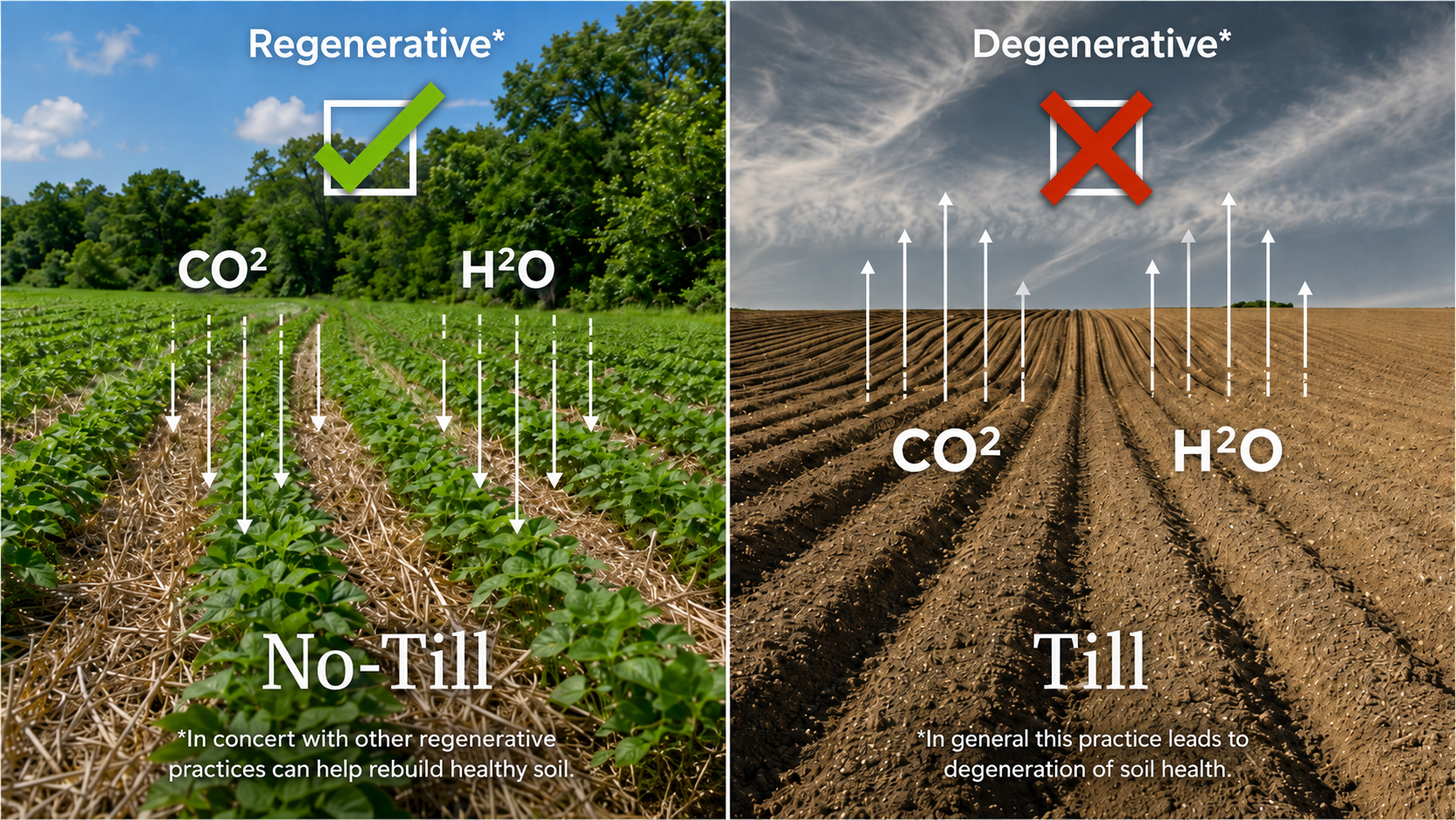
Tilling turns over the top 150–250 mm of soil before planting, burying residue and weeds and briefly warming and aerating the ground. It feels productive - that's why it caught on. But undisturbed soil works like a sponge, held together by soil particles and the channels made by roots and soil life. Every pass of the plough breaks that sponge apart.
Tillage kills the mycorrhizal fungi that feed nutrients to plants, build water-holding aggregates and help plants resist disease and pests.
Bare, pulverised soil is easily stripped by wind and rain, and absorbs water more slowly - so more runs off, taking topsoil with it.
Ploughing exposes soil carbon to the air, where it oxidises into carbon dioxide - a direct contribution to climate change, paddock by paddock.
The microbes and insects that build healthy soil are displaced or killed, and evaporation increases from the disturbed surface.
No-till is nothing new: it's how crops were grown as far back as 10,000 years ago. Tilling only became the norm during the agricultural revolution of the 18th and 19th centuries, when improved plough designs let farmers plant more seed with less effort. What those farmers couldn't see was the long-term cost: used deeply and repeatedly, tillage can turn a living soil into a lifeless growing medium dependent on chemical inputs to produce anything at all.
Intact structure and surface cover soak up rain, slow evaporation and hold moisture - a real advantage in hot, dry spells.
Better infiltration means less runoff, less erosion, and less sediment and nutrient pollution reaching your waterways.
Left undisturbed, fungi and bacteria build stable communities that cycle nutrients, suppress disease and steadily improve structure.
Direct drilling removes whole passes over the paddock - cutting fuel use by roughly 50–80% and labour by 30–50%.
A common misconception is that no-till only works with genetically engineered crops and heavy herbicide use. In truth there are two distinct approaches - and the difference matters.
Weeds are managed with herbicides before and after sowing. It protects soil structure, but herbicide use in this approach can actually exceed tillage-based farming - with the environmental and health risks that come with it.
Weeds are managed without chemicals: cover crops, crop rotation, free-range livestock, and tools like the roller crimper, which lays a weed-suppressing mat you can plant straight through in one pass. It isn't a cure-all on its own - but combined with other regenerative practices it moves the whole system toward health.
No-till works best woven together with other practices from the kete - diverse seed mixes, dense mob grazing and cover cropping all feed the same living soil.
Soil naturally stores carbon. Ploughing brings that carbon to the surface where it becomes carbon dioxide; keeping the soil covered and undisturbed keeps the carbon in the ground. Healthy soil isn't just about reducing emissions - it's one of the few tools we have for drawing down carbon that's already in the atmosphere.
Figures like these come from specific trials - here, the Rodale Institute's organic no-till with cover cropping - and won't be matched on every farm. Soil type, climate and management all change the result, so treat them as what's possible, not a guarantee.
The Rodale Institute has estimated that if regenerative practices were adopted worldwide, soils could sequester a very large share of annual global greenhouse-gas emissions - a figure sometimes put at around 52 gigatonnes of CO₂. That's an optimistic, much-debated estimate rather than a settled number, and no single practice gets there. But the direction is sound: combined with cover cropping, agroforestry and multispecies livestock rotation, no-till helps build genuinely climate-resilient farms.