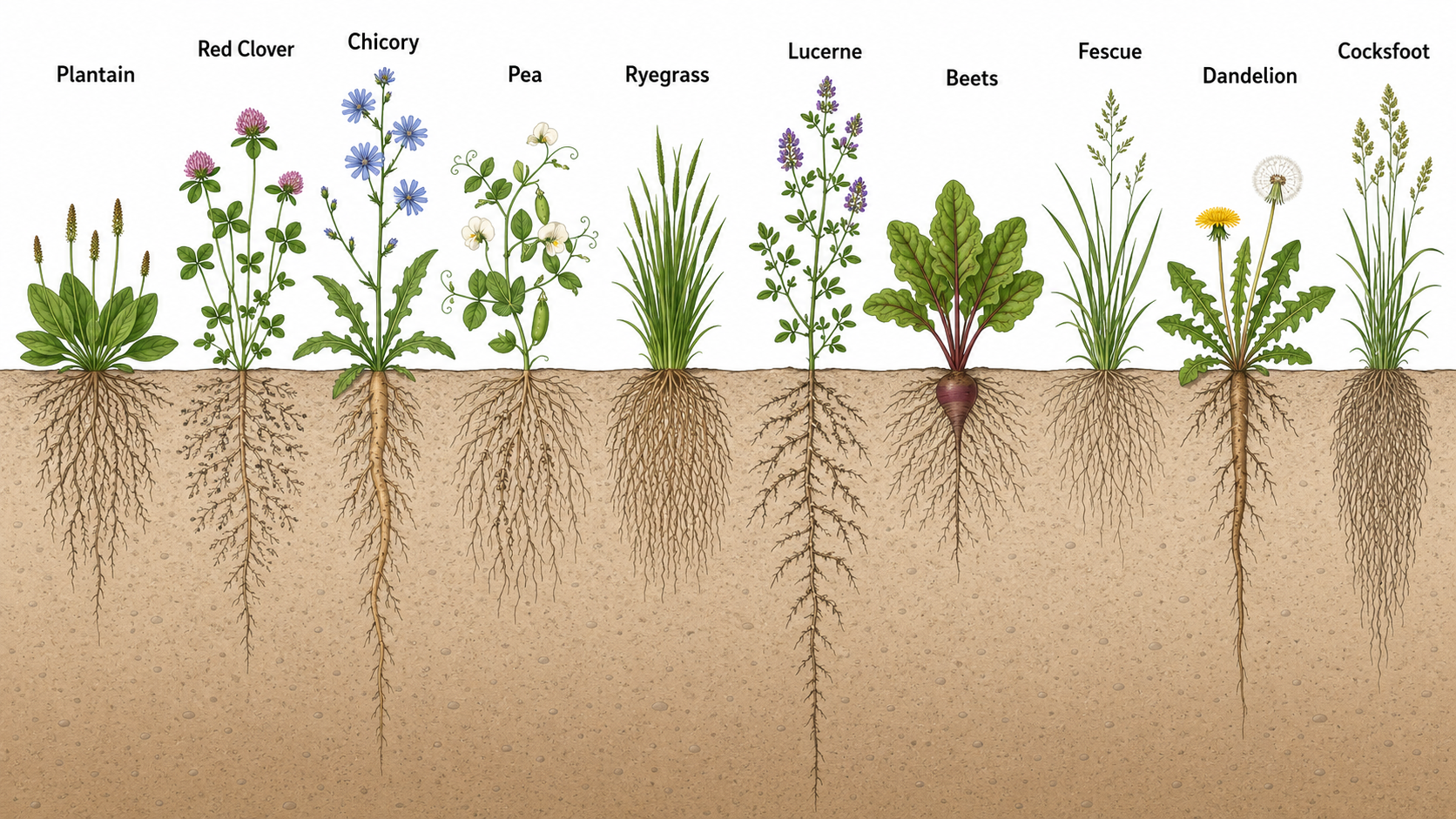
Fostering diversity delivers a whole cascade of benefits at once - secondary plant compounds, improved nutrition for grazing, beneficial insects, weed competition, mycorrhizal partnerships, better access to water, greater soil microbial diversity, nutrient exchange and humus. Optimising this biological diversity isn't a nice-to-have; it's critical to how a pasture actually functions.
Getting a mix that suits your context is key for regeneration, and mixes will vary with the farming system - dairy, dry stock and mixed cropping all call for different blends. No mix is regenerative or degenerative in itself; it depends on how and where it's used. The other key distinction is lifespan. Perennials live more than two years (the term also covers non-woody plants, as opposed to trees and shrubs); annuals complete their whole life cycle in one growing season and must be re-sown each year.
The tables below are a starting reference of species and sow rates. Your final mix should suit your soils, climate and system - a seed merchant or farm adviser can tailor it.
A closer look at ten of the workhorse species you'll meet in diverse Taranaki swards.
Highly palatable, quick to establish, pest-tolerant and high in minerals. A fibrous, coarse-rooted herb that handles summer heat well and gives valuable summer growth in warmer regions - well suited to dairy where summer feed quality limits milk. Grow it as a pasture mix; if grazing management is adaptive, crop can last for many years.
A pea-family legume and important fodder/rotation crop. Tap-rooted and a strong nitrogen fixer - good cultivars can fix over 200 kg N/ha - it adds nitrogen to pastures slowly and continually, increasingly valuable as fertiliser comes under environmental scrutiny. Red clover is often treated as short-lived, but poor persistence usually comes from grazing managed around ryegrass rather than the clover; under adaptive grazing that suits it, red clover can persist long-term.
A perennial legume and the ideal companion to ryegrass: summer-active (optimal temperature 5 °C above ryegrass), it holds feed quality in late spring when grasses run to seed, and fixes nitrogen that lifts total pasture production and builds organic matter. Best on moderate-to-high fertility soils; less persistent in dry situations.
Grown as a special-purpose crop or in a grass/clover mix. Sow into warm soils (12 °C) under 10 mm deep, ideally in spring. First graze no earlier than the seven-leaf stage (about eight weeks after spring sowing) so tap roots develop. Prefers free-draining silt loams; avoid heavy, poorly drained clays. Tolerates acidity (optimal pH 4.5–6); high pest tolerance makes it a summer alternative to turnips.
Whole-crop pea forage can be grazed, green-chopped, made into hay or ensiled, with or without pods at varying maturity. Harvest residues - pea straw or haulms - are a useful by-product.
A perennial ryegrass pasture is a population of plants, each made of tillers carrying up to three live leaves, with the growing point safely at the base where grazing can't damage it. The live leaf is the most digestible, milk-sustaining part. Ranges from annual (under 1 year) and Italian (1–2 years) through short-rotation (2–5 years) to perennial (about 5 years).
An erect perennial legume that fixes nitrogen and sends a deep taproot below 2 m, giving strong moisture-stress tolerance. Cool-season growth is less than ryegrass but warm-season growth and quality are much better, so it complements other pastures. Persists 5–8 years-plus with good management; a flowering spell in Feb–March rebuilds root reserves. Sow spring, inoculated, into well-drained paddocks at pH above 6.
An alternative to perennial ryegrass where high soil temperatures limit summer growth or ryegrass won't persist. It cannot be mixed with ryegrass. Greater summer growth, deeper roots, and tolerance of a wider pH and waterlogging range - but grazing must be managed more strictly to hit its nutritive potential.
Common in pastures and no real problem - stock eat the leaves, which Massey research found significantly higher than ryegrass and clover in phosphorus, magnesium, sodium, copper, zinc and boron. Its deep taproot stays green through drought, drawing water from deep in the profile.
The most persistent pasture grass - drought- and pest-tolerant (including grass grub) - though typically lower in feed value than ryegrass. Usually a minor component (2–3 kg/ha) of summer-dry dairy mixes to lift summer growth; newer fine-leaved cultivars are easier to manage.
Two real mixes to show how species come together for different systems. Treat them as inspiration, not prescription - your merchant or adviser will tune rates to your farm.
Dry stock farms are typically large with varied landscapes and soils - consult a seed merchant or farm adviser to match diverse mixes to the whole farm or to individual paddocks.